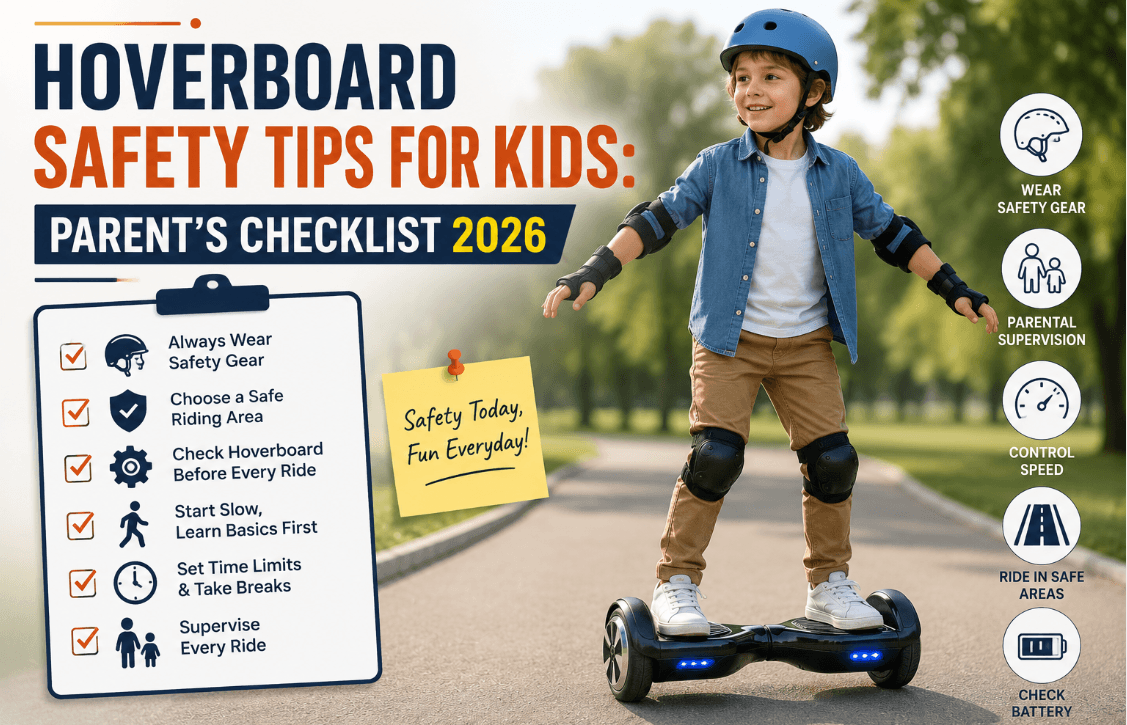
Hoverboard Safety Tips for Kids: Parent’s Checklist 2026
Written by the Kunshop Mobile Accessories Team. Reviewed for accuracy on [August \ 2026].
Your kid’s been asking for a hoverboard for weeks. Part of you pictures the fun. The other part pictures a very avoidable trip to urgent care. Both reactions are fair, honestly. Hoverboard safety tips for kids aren’t really about saying no — they’re about making sure the fun part is the part that actually happens. Here’s what I’d want to know before handing one over: how to pick the right board, what gear actually matters, and how to teach a first-timer without a bruised elbow by day two. If you’re still comparing models, our hoverboard buying guide is a good place to start before you shop.
Are Hoverboards Safe for Kids?
Yes, mostly — if a few things line up first. The board needs to be properly certified, your kid needs to actually be ready for it, and the riding spot has to make sense. Miss any one of those and you’re gambling on the same three things every time: a fall from losing balance, a battery overheating because it’s cheap or damaged, or a collision because someone rode somewhere they shouldn’t have.
None of this is meant to scare anyone off. It’s meant to point out that these risks are, for the most part, preventable. Certified board, decent gear, a few ground rules — that covers most of it. That’s really the whole point of this checklist.
What Age Is Safe for a Hoverboard?
Most brands say 8 and up. But age is a rough proxy at best, and you probably already knew that. A calm, coordinated 7-year-old can sometimes handle it better than a distracted 10-year-old who won’t slow down for anything. What matters more is whether they’ll actually listen when things get wobbly, whether their legs are strong enough to control weight shifts, and whether they meet the manufacturer’s weight requirements — check the manual, since this varies by model quite a bit.
Not sure where your kid stands? Watch them on a scooter or bike first. Kids who’ve already got the hang of balancing on wheels tend to pick this up faster, with fewer spills along the way. If a hoverboard still feels like a stretch, our kids hoverboards range includes slower, beginner-friendly options built with younger riders in mind.
Hoverboard Safety Checklist for Parents
Keep this one handy — before you buy, before each ride, and while they’re out there riding.
Before You Buy:
- UL 2272 certification: Look for the label on the box and on the board itself, not just mentioned somewhere in the listing text.
- Weight and age range: Match the stated limits to your child’s actual size, not just their birthday.
- Speed settings: Pick a model with a beginner or adjustable speed setting that fits their experience.
- Wheel size and model: Go with whatever the manufacturer recommends for the child’s age, weight, and riding environment.
- Return policy: Buy from a seller with a real warranty, just in case the unit’s off somehow.
Before Every Ride:
- Gear check: Helmet, wrist guards, elbow and knee pads — on and fastened, not draped over an arm somewhere.
- Battery check: No swelling, weird smells, or damage around the casing or charging port.
- Surface check: Flat, dry, nothing loose scattered around like gravel or sticks.
- Footwear check: Closed-toe shoes with actual grip. Socks and sandals don’t count.
- Supervision check: Someone’s actually watching, not half-watching from inside the house.
During the Ride:
- Stay in the cleared area: No streets, no driveways with cars coming and going, no crowded paths.
- Keep both feet planted: No hopping on or off mid-motion, ever.
- Ride at a controlled speed: Beginners stick to low or training mode, no shortcuts.
- Watch for obstacles: Curbs, cracks, uneven pavement — these trip up new riders constantly.
- Stop and dismount slowly: A lot of falls happen right at the moment someone stops too fast.
Choosing a UL 2272-Certified Hoverboard
UL 2272 is worth checking before you spend a dime. It’s a testing standard from Underwriters Laboratories that looks at the battery, charger, and motor for fire and electrical risk. Boards that pass have been through overcharge tests, short-circuit tests, and mechanical stress tests — the kind of testing that addresses a lot of what caused hoverboard fires to make headlines a few years back. That said, certification lowers risk. It doesn’t make a board bulletproof, and it’s not a guarantee nothing will ever go wrong.
To check it, look for the UL 2272 mark on the box, plus a matching label on the underside of the board. No mark anywhere? I’d walk away, no matter how good the online reviews look. Our full range of hoverboards in Pakistan is UL 2272 certified, so that part’s already handled for you.
Essential Protective Gear for Kids
Treat gear like a bike helmet rule — non-negotiable, every single ride, no exceptions for “just around the driveway.” The core setup covers what’s most likely to hit the ground first: head, wrists, elbows, knees.
- Helmet: CPSC-certified, fitted snugly, not just balanced on top of their head.
- Knee pads: Cushion the sideways falls hoverboards seem to specialize in.
- Elbow pads: Cover the scrapes from when a kid instinctively throws their arms out.
- Wrist guards: Add extra protection if they fall and catch themselves with their hands.
- Closed-toe shoes: Sneakers with grip. Not flip-flops, not sandals, not bare feet.
Hoverboard Safety Rules for Children
Short rules stick better than long ones. A lecture gets tuned out somewhere around sentence three — you know this already if you’ve got kids. So set the expectations before the first ride, not right after the first fall.
Speed comes first: beginner or training mode until they can stop, turn, and balance without wobbling everywhere. Pair that with close supervision for the first couple of weeks — actually watching, not just being in the general vicinity. Once the basics are clearly down, you can start backing off. Doesn’t need to happen all at once, and honestly it shouldn’t.
How to Teach a Child to Ride a Hoverboard Safely
Start in a dry, flat, open space, away from traffic and clutter, and check the manual for what surfaces the manufacturer actually recommends. Have them practice stepping on one foot at a time first, holding a wall or your hand, just getting used to the platform before it’s even switched on.
Once they’re moving, keep the early sessions short — five, maybe ten minutes at a time. Teach the “step back to stop” move early, since panicking and jumping off sideways is a common way beginners end up falling. Confidence builds over a handful of sessions, not one enthusiastic afternoon, no matter how badly they want it to. For a slightly older rider who’s outgrowing training mode, our guide on hoverboard safety tips for beginners covers the next stage.
Where Can Kids Safely Ride a Hoverboard?
Location matters just as much as the board itself does. A flat driveway, an empty garage, a quiet park path — all solid picks. Steer clear of anything with car traffic, steep slopes, water, or loose gravel. Hoverboards just don’t do well on uneven ground, full stop.
Nighttime riding is another one to skip, at least early on. Visibility drops for everyone — the rider, pedestrians, drivers pulling out of driveways — so it’s smarter to save night rides for later, once your kid’s experienced and the board has decent LED lighting.
Hoverboard Battery and Charging Safety
Battery problems are rare on certified boards, but charging habits still matter more than people think. Never leave it charging overnight or step away for hours — charge on a hard, non-flammable surface, not a carpet, not a bed.
Stick to whatever charger the manufacturer specifies. Something incompatible can create risks you really don’t need — our hoverboard chargers collection only stocks chargers matched to the boards we sell, so compatibility isn’t something you have to double-check yourself. And if the battery ever feels hot, smells off, or looks swollen at all, unplug it right away and hold off using the board until someone’s had a look. For the full routine, see how to charge a hoverboard properly.
Hoverboard Maintenance Tips for Long-Term Safety
A little upkeep goes further than most people expect. Wipe down the wheels and footpads after outdoor rides, check for loose screws or cracks every few weeks, and store it somewhere dry — not a damp garage corner where it just sits collecting dust.
Worth glancing at the manufacturer’s app or manual now and then in 2026, too. Firmware updates on newer models can improve things like speed limiting and battery management over time, and it’s an easy thing to overlook. If your child’s outgrowing their current board, our electric scooters in Pakistan range is worth a look as the next step up.
Common Hoverboard Accidents and How to Prevent Them
Falls, collisions, and losing balance are the risks worth thinking about here, and they usually come down to one of three things: no protective gear, riding on uneven ground, or going faster than the rider can actually handle.
None of that’s complicated to fix. A kid who wears gear every time, sticks to flat ground, and starts slow each session is a lot less likely to get hurt than one who figures “just this once” is probably fine.
Frequently Asked Questions
Q: What age is safe for a hoverboard?
A: Most manufacturers recommend age 8 and up, but readiness comes down more to balance, coordination, and meeting the board’s weight requirement than age by itself.
Q: Do kids need helmets for hoverboards?
A: Yes. A properly fitted, CPSC-certified helmet matters a lot here, since head injuries from falls are one of the more serious risks involved.
Q: How do I know if a hoverboard is safe from fire risk?
A: Look for the UL 2272 certification label on the box and the board itself. It confirms the battery and electrical system passed independent testing for fire and overheating risk, though no certification removes risk completely — the CPSC also publishes hoverboard safety guidance worth a look.
Q: Can hoverboards be ridden at night?
A: Better to avoid it, especially for beginners. Visibility drops fast after dark, which makes things harder for the rider and everyone around them.
Q: What’s the biggest cause of hoverboard accidents?
A: Falls, collisions, and loss of balance top the list, and they’re most often linked to riding too fast, on uneven surfaces, or without protective gear.
Q: How long should a hoverboard charge before first use?
A: Check the manufacturer’s manual instead of guessing. Charging times vary quite a bit by model, so there’s no single number that applies everywhere — just always charge on a hard, non-flammable surface.
Final Verdict
Hoverboards really can be a safe, fun ride for kids. The gap between “great experience” and “trip to urgent care” usually just comes down to prep. Get a UL 2272-certified board, gear your kid up properly, pick a sensible riding spot, and stay on top of battery habits — that covers pretty much everything on this list. Keep it somewhere handy for the first few months, and pull it back out whenever your child moves up to a faster board or a new place to ride.
Ready to shop? Explore our hoverboard collection online in Pakistan — genuine, UL 2272-certified boards, competitive prices, nationwide delivery, and reliable customer support from KunShop.pk.