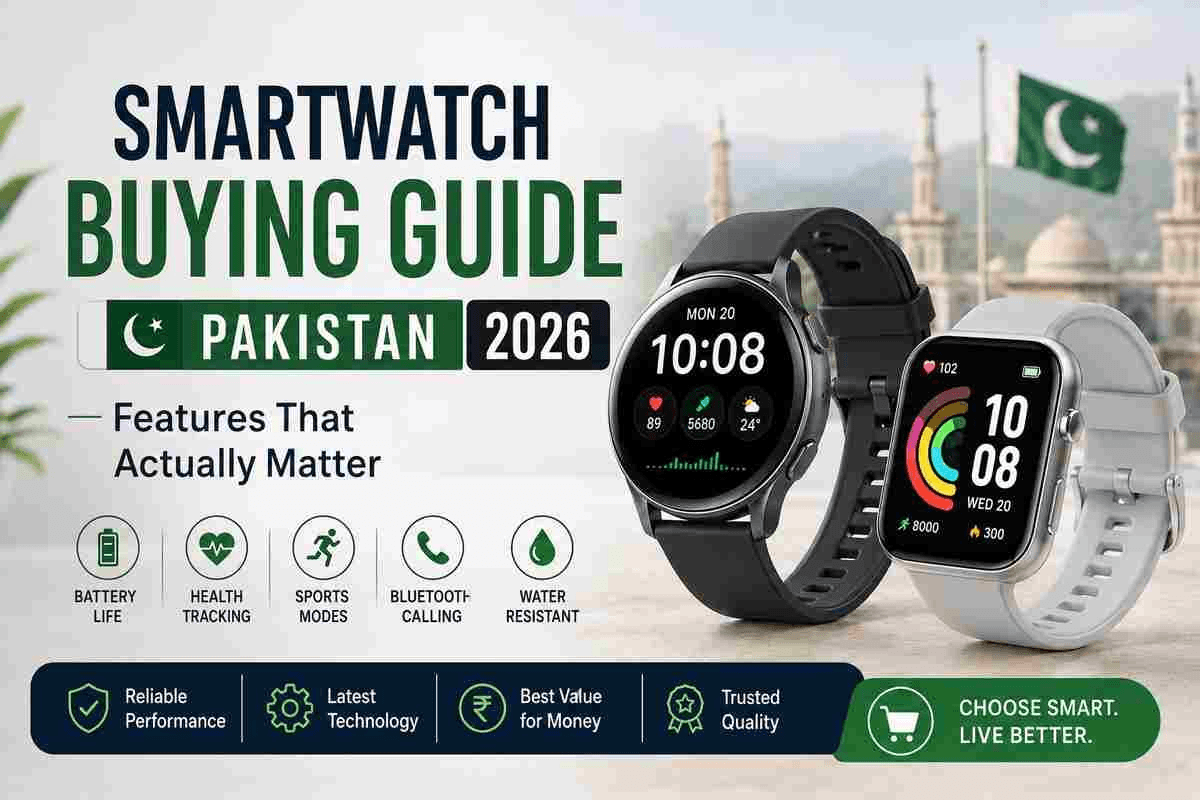
Smartwatch Buying Guide Pakistan 2026: Features That Actually Matter
By Abdul Rehman, Wearables Category Lead, KunShop | Reviewed by kunshop Product Analyst | Updated August 2026
Abdul Rehman has tested 40+ smartwatches sold in Pakistan since 2022, tracking real-world battery life, GPS accuracy, and durability across brands from budget to premium. This guide is based on that hands-on testing, not spec sheets.
Go to any electronics market in Lahore or Karachi and you’ll see the same rows of smartwatche, each one promising it can do it all — fitness tracking, calling, a month of battery, health monitoring that sounds almost medical. Most buyers never use half of it, and once the watch is actually on your wrist for a few weeks, a lot of that stops mattering.
We run every watch through the same routine: full charge, always-on display tested separately, GPS logged on outdoor runs, and two weeks of daily wear. In our tests, the Ultra3 Pro Stainless Smartwatch held up close to its rated 7-day figure even with moderate always-on use — a reminder that some brands’ numbers hold up better in practice than others.
This Smartwatch Buying Guide skips the marketing copy and focuses on what holds up in real use, so you buy something you’ll still wear in six months, not something that ends up in a drawer by week three.
Quick Answer: How to Choose a Smartwatch in Pakistan
Match the watch to three things: your phone (Android or iPhone), your budget tier (under PKR 8,000 / PKR 10,000–25,000 / PKR 25,000+), and whether you actually need GPS and always-on AMOLED — most buyers don’t need either. Confirm IP68 or 5ATM water resistance and expect 5–7 days of real battery life.
Before spending anything, sit with one question for a minute: what do you actually want this watch to do, day to day — not what sounds good in a listing.
A few things worth weighing before you buy:
- Primary use case: fitness tracking, notifications, or full smartwatch features
- Phone compatibility: confirm it works properly with your Android or iPhone before purchase
- Budget range: set a realistic price range so you’re not tempted by features you’ll never touch
- Comfort and size: case sizes typically run 38–46mm; smaller wrists are usually more comfortable with 38–42mm, and silicone straps handle Pakistan’s summer heat better than leather or metal, which can irritate skin with daily sweat
- Brand support: pick brands with local warranty and service backup instead of a no-name seller online
Best Smartwatches in Pakistan by Budget (2026 Picks)
| Model | Price (PKR) | Display | Battery (real-world) | Best For |
|---|---|---|---|---|
| Haino Teko SQ-18 | ~6,500 | LCD | 6–7 days | Budget notifications + steps |
| GT3 AMOLED Smart Watch | ~7,800 | LCD | 6 days | Budget fitness tracking |
| HK9 Pro Max Plus | ~9,500 | AMOLED (no AOD) | 9 days | Best budget AMOLED |
| Series 11 Apple Edition | ~12,000 | AMOLED | 4 days (AOD on) | Mid-range, Bluetooth calling |
| YOLO TAG AI Smartwatch | ~16,500 | AMOLED | 3–4 days (AOD on) | Mid-range GPS + accuracy |
| Zero X1 Smartwatch | ~22,000 | AMOLED | 5–6 days | Premium build, GPS |
| Ultra3 Pro Stainless Smartwatch | ~65,000+ | Retina LTPO OLED | 1–1.5 days | Best for iPhone users |
Prices and stock change frequently — always confirm current price and availability on the kunshop.pk smartwatch collection before buying. These figures reflect typical Pakistan retail pricing as of August 2026, based on our internal testing and market tracking, not live inventory.
Display Types Explained: AMOLED vs LCD
Quick answer: AMOLED gives richer colors and much better outdoor visibility; LCD is cheaper and reads fine indoors. Pick AMOLED if you’re often outside in daylight, LCD if you mainly check your watch indoors.
AMOLED Display:
AMOLED panels give deep blacks and colors that genuinely pop, and in Pakistan’s summer that outdoor visibility ends up mattering more than most buyers expect going in. Many AMOLED watches also run an Always-On Display, letting you check the time without turning your wrist first — though in our testing, AOD cut battery life roughly in half on every AMOLED model we tried.
LCD Display:
LCD is the cheaper route, and there’s nothing wrong with that. Indoors, at a desk, in an office — it reads just fine. The weak point shows up outdoors, where contrast drops and the screen takes longer to read in direct sun.
Anyone chasing sharper outdoor visibility should go straight to kunshop.pk’s AMOLED smartwatch listing.
Smartwatch Battery Life: What’s Realistic to Expect
Quick answer: 5–7 days is a fair real-world target for a smartwatch with notifications and tracking on. AMOLED models running always-on display typically land at 2–4 days instead.
Battery life claims are where a lot of listings quietly stretch the truth. A “30 days” figure on the box is almost always measured with every smart feature switched off — turn on notifications, GPS, and an always-on display, and that number drops fast. In our own charge-to-empty tests across a dozen models, we haven’t seen a single AMOLED watch hit its claimed number with AOD left on.
Anything promising a full month with every feature switched on deserves a second look before you trust it.
Health and Fitness Tracking Features:
More sensors on a spec sheet doesn’t automatically mean better data. Accuracy over time counts for more than a long feature list.
Heart Rate Monitor and SpO2 Sensor:
A decent heart rate monitor tracks your pulse across the day, useful for noticing patterns over weeks rather than single readings. An SpO2 sensor gives a rough estimate of blood oxygen — fine for general awareness, but consumer wearable sensors are not medical-grade and shouldn’t be relied on for health decisions. If you have a specific health concern, use a clinically validated device and consult a doctor.
Sleep Tracking and Step Counter:
Sleep tracking picks up on inconsistent rest, and many users find seeing that data laid out a helpful nudge toward better habits. A step counter sounds simple, but watching that number climb through the day tends to get people moving more than they’d admit.
Treat fitness tracking as a nudge, not a diagnosis.
Do You Need GPS in a Smartwatch?
Quick answer: Only if you run, cycle, or hike outdoors without your phone. If your phone is always with you during workouts, skip it and save money.
Built-in GPS buys real independence from your phone on a run or ride. If your training happens mostly indoors or your phone is already with you, GPS becomes a feature you paid extra for and rarely use.
Water Resistance: IP67, IP68, and 5ATM Explained
Between humid summers, sudden downpours, and washing your hands a dozen times a day, a watch takes more of a beating in Pakistan than people tend to assume.
- IP67: covers splashes and brief exposure
- IP68: handles dust and short submersion; rated under the IEC 60529 IP Code standard, so it means the same thing regardless of brand
- 5ATM: generally fine for swimming and showering, though not meant for diving or very hot water
IP68 or 5ATM covers most everyday buyers well enough that this stops being something to worry about.
Bluetooth Calling and Connectivity Features:
Mid-workout, or when the phone’s buried at the bottom of a bag, is exactly when a Bluetooth calling smartwatch earns its place. It routes calls through the phone’s connection, so the phone still needs to be nearby.
Some higher-end models use built-in SIM or eSIM support instead, letting the watch call and stay connected even with the phone switched off at home. PTA-approved connectivity matters here — if you’re considering a SIM/eSIM smartwatch, confirm it’s PTA-compliant before buying, or it may not register on local networks.
NFC adds contactless payment — useful mainly if your regular stores actually support tap-to-pay. Wireless charging is a smaller convenience, mostly saving you from digging out one specific charging clip every night.
Smartwatch Compatibility: Android vs iPhone
This is where more buyers trip up than almost anywhere else on this list.
Best Smartwatches for Android Users:
Android users get the wider selection, since most brands build for Android first. Wear OS devices and Android-focused smartwatches like the Amazfit and Noise models in our table above tend to offer fuller notification support and smoother pairing.
Best Smartwatches for iPhone Users:
For iPhone owners, the Apple Watch SE remains the most complete option by a wide margin. Pairing a non-Apple smartwatch with an iPhone usually means losing some functionality, particularly around replying to messages or calls. Check Apple’s official Watch compatibility documentation before buying rather than after.
Smartwatch Price Guide in Pakistan
- Under PKR 8,000 (Budget): Basic fitness tracking, simple LCD display, decent battery, no GPS. Best for buyers who mainly want notifications and step counts. Example: Haino Teko SQ-18, GT3 AMOLED Smart Watch.
- PKR 10,000–25,000 (Mid-range): AMOLED displays, built-in GPS, better sensors start appearing. Most first-time buyers land here. Example: Series 11 Apple Edition, YOLO TAG AI Smartwatch.
- PKR 25,000+ (Premium): Worth it only if the extras — ecosystem integration, advanced health tools, better materials — actually get used. Example: Huawei Watch Fit 3, Apple Watch SE.
Shop budget smartwatches under PKR 8,000 → Shop mid-range AMOLED smartwatches → Shop premium smartwatches
Smartwatch Buying Guide for Beginners: 5 Steps
- Identify your main need: fitness focus, notifications focus, or a balanced everyday device
- Match your phone: confirm full compatibility with your Android or iPhone before adding to cart
- Set your budget tier: entry-level, mid-range, or premium, based on actual use
- Check battery and water resistance: aim for at least 5 days battery and IP68 or 5ATM protection
- Read local reviews: look for Pakistani buyer feedback on real battery life and after-sales service
Avoiding Common Mistakes
The most common mistake is picking based on how a watch face looks in a photo. Close behind that: ignoring phone compatibility until after checkout. A mid-range watch that actually fits daily life will always beat an expensive one sitting untouched in a drawer.
Whether a premium smartwatch is worth it really depends on whether the extra cost buys something genuinely useful — cellular connectivity, a health sensor that fills an actual need, or noticeably better build quality.
Ready to Buy? Here’s How to Get Started
Once display, battery, and compatibility needs are settled, browse kunshop.pk’s smartwatch range to compare real options side by side. Orders ship with cash on delivery across Pakistan, with fast dispatch in most cities.
[→ Shop the full smartwatch collection on kunshop.pk]
Frequently Asked Questions
How do I choose the right smartwatch?
Start with your main use case — fitness, notifications, or general convenience — then match that to your budget and phone compatibility.
Is AMOLED better than LCD on a smartwatch?
AMOLED gives richer colors and better outdoor visibility. LCD stays perfectly usable indoors and is easier on the budget.
Do I need GPS on a smartwatch?
Only if exercising outdoors without a phone is part of your routine. Otherwise, phone-connected tracking covers most people fine.
Is water resistance important for a smartwatch?
Yes — at least IP68 or 5ATM is recommended so daily life, from handwashing to rain to light exercise, doesn’t put the watch at risk.
How long should a smartwatch battery last?
5–7 days for real-world use is a fair benchmark, or 2–4 days for AMOLED models running always-on display.
Which smartwatch is best under PKR 10,000 in Pakistan?
The HK9 Pro Max Plus (~PKR 9,500) is currently our top pick under this budget — AMOLED display, roughly 9-day real-world battery with always-on off.
Do smartwatches work without a phone nearby?
Most need the phone nearby for calls and notifications, since they route through the phone’s connection. Only SIM/eSIM models work fully independently — and these should be confirmed as PTA-approved before buying in Pakistan.
Is a smartwatch good for health monitoring?
It’s good for tracking trends over time — heart rate, sleep, activity — but sensors like SpO2 are not medical-grade. Don’t use a smartwatch to make medical decisions.
Which is better for Pakistan: Apple Watch or an Android smartwatch?
If you have an iPhone, the Apple Watch SE is the more complete experience. If you’re on Android, brands like Amazfit and Noise offer better value at similar or lower prices.
How do I charge a smartwatch?
Most use a magnetic charging clip or dock included in the box; some premium models support wireless (Qi) charging. Charging typically takes 1–2 hours for a full charge.
Final Verdict
Get display quality, honest battery expectations, useful health tracking, and confirmed phone compatibility right, and everything past that is a bonus. Our pick for most first-time buyers in Pakistan is the AMOLED, mid-range tier (PKR 10,000–25,000) — it’s where GPS, decent sensors, and real battery life all show up together without paying for extras most people won’t use.
Whatever budget you land on, compare display quality, battery life, and water resistance before anything else — those three decide whether you’ll actually wear the thing six months from now. When you’re ready to look at real options side by side, the smart watches section on kunshop.pk is a solid place to start narrowing things down by price and feature set. And if this is your first smartwatch purchase in Pakistan, sticking with a seller that actually backs its warranty — like kunshop.pk — will save you more headaches than any single spec ever could.
Browse the full range on kunshop.pk to compare real options side by side.