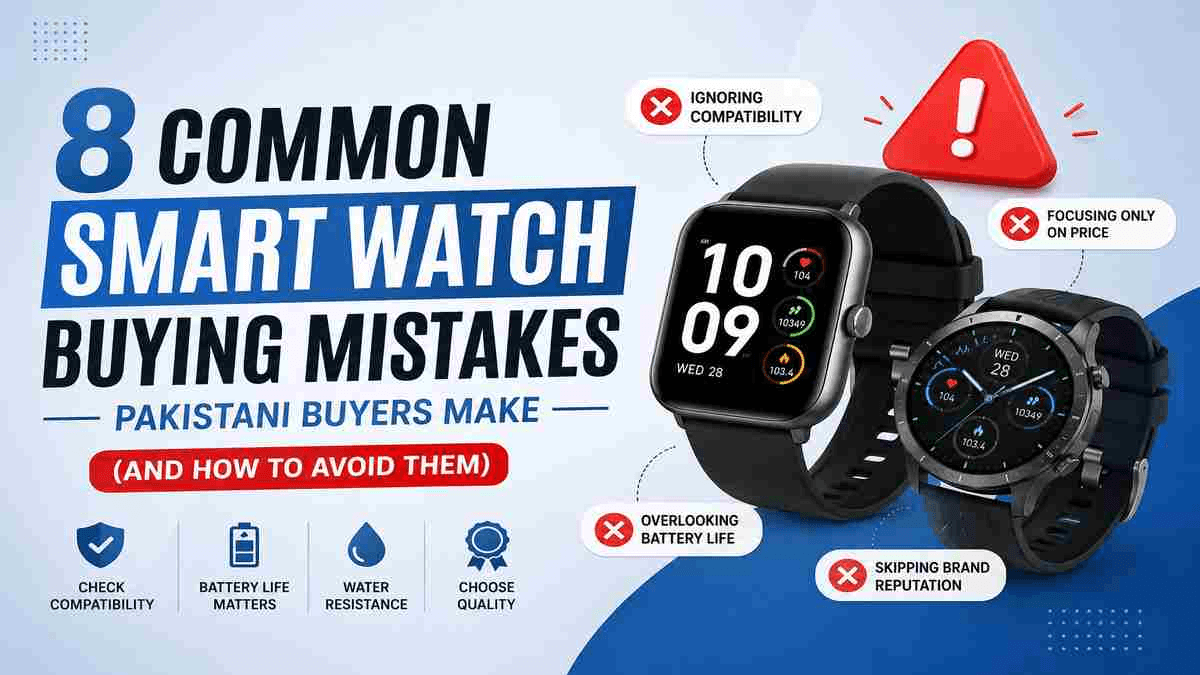
8 Common Smart Watch Mistakes Pakistani Buyers Make (And How to Avoid Them)
Reviewed by the KunShop.pk Product Team — Last updated August 2026
Buying a smart watch in Pakistan sounds simple until you actually start scrolling through Daraz listings or walking into a local mobile market. One seller swears their Rs. 3,500 watch has “medical-grade” health tracking. Another tells you the battery lasts two weeks, but the reviews say otherwise. Somewhere in between all that noise, most buyers end up making at least one of the same handful of smart watch buying mistakes — and only realize it after the watch stops syncing, the strap cracks, or the “waterproof” claim turns out to be nothing more than marketing.
This guide walks through the eight mistakes we see Pakistani buyers make most often, why each one costs you money or frustration, and what to check instead. Think of it as a practical smart watch buying guide for Pakistan rather than a spec sheet — the kind of thing a friend who’s already been burned once would tell you before you hand over your cash.
Quick answer: Before buying any smart watch in Pakistan, check four things — phone compatibility, the actual battery mAh figure (not “days of use” claims), a numbered IP rating instead of the word “waterproof,” and whether the seller offers a real, written warranty. Skipping any one of these is where most buyer regret starts.
What to Check Before You Buy a Smart Watch in Pakistan
Before getting into individual mistakes, it helps to know how to choose a smart watch in Pakistan at a glance. Four things decide whether a watch will still feel worth it six months from now: does it work with your phone, does it survive a normal week without dying on you, does the seller actually stand behind it, and are you paying for features you’ll realistically use.
Everything else — colors, watch faces, how many sport modes it claims to have — is secondary. Keep those four questions in mind as you read through the mistakes below, because most of them trace back to skipping one of these checks.
Mistake 1: Ignoring Phone Compatibility
A lot of buyers assume every smartwatch works the same way with every phone, and that’s not quite true. Some smart watches for Android lean heavily on Android-specific notification permissions, while a smartwatch for iPhone often loses features like full notification replies or third-party app alerts because of how iOS restricts background access.
Before buying, check which companion app the watch uses — DaFit, WearFit, Zepp, and similar apps all handle Android and iOS compatibility differently. Look up that specific app on the Google Play Store or App Store and read recent reviews, not just the star rating, since older reviews sometimes describe a version of the app that’s already been replaced.
Mistake 2: Not Checking Battery Life Before Buying
Smartwatch battery life is one of the most exaggerated specs in local listings. A watch advertised as lasting “10 days” often means 10 days with notifications only, screen brightness low, and no Bluetooth calling — turn on always-on display or health tracking and that number drops fast.
A more realistic way to judge battery capacity is to look for the actual mAh figure rather than marketing claims, and to treat any listing that only says “long battery life” with some suspicion. As a rough guide, 3-5 days of real-world use with notifications and basic fitness tracking on is a reasonable expectation for most budget and mid-range watches sold in Pakistan — we’ll come back to this same number when comparing price tiers below, so it’s worth remembering.
Mistake 3: Trusting “Waterproof” Without an IP Rating
Smart watch water resistance explained simply: there’s no such thing as a truly “waterproof” smartwatch, only degrees of water resistance measured by an IP rating, a standard defined by the International Electrotechnical Commission. A watch rated IP67 can handle sweat, rain, and an accidental splash from washing your hands, but it isn’t meant for swimming or a long shower.
If a listing just says “waterproof” with no number attached, that’s usually a sign the seller either doesn’t know the actual rating or is rounding up. Ask directly for the IP rating before ordering, especially if you plan to wear the watch during wudu, workouts, or Lahore’s monsoon season. Browsing GT3 AMOLED Smart Watch on kunshop.pk is a quicker way to filter for this than reading every product description line by line.
Mistake 4: Overestimating Health Tracking Accuracy
Heart-rate monitoring, SpO2, and sleep tracking are everywhere in smartwatch marketing now, and they’re genuinely useful for spotting trends over time. What they’re not is a replacement for medical equipment — even Apple’s own support documentation on heart rate accuracy notes that skin perfusion, tattoos, and motion type can all affect sensor readings on flagship devices, let alone budget ones.
Smartwatch accuracy on budget devices tends to be even less consistent, so treat the numbers as a general pattern rather than a diagnosis. If you have an actual health concern, a doctor’s opinion matters more than anything your wrist is telling you.
Mistake 5: Skipping the Warranty Check
Smart watch warranty in Pakistan varies wildly between sellers, and this is one of the easiest mistakes to avoid simply by asking upfront. Some listings quote a warranty period without saying whether it covers the strap, the charging dock, or just the main unit — and “warranty” from an unregistered seller with no physical address often means nothing once the watch stops working.
Before you order, confirm the return policy window, whether after-sales support is handled locally or requires shipping the watch elsewhere, and whether the seller has a real service history you can find reviews for. A watch that’s Rs. 500 cheaper but has no real warranty backing usually ends up costing more in the long run.
Mistake 6: Buying on Price Alone
Cheap vs expensive smart watch Pakistan comparisons usually miss the point — the question isn’t whether to spend more, it’s whether the price matches what you’re actually getting. A Rs. 2,500 watch and a Rs. 8,000 watch can look nearly identical in photos, but the difference often shows up in build quality, sensor reliability, and how long the touchscreen stays responsive.
That said, spending more doesn’t automatically mean better either. Plenty of buyers overpay for a brand name attached to the same internal hardware found in cheaper alternatives. The smarter approach is comparing specific specs — display type, battery capacity, water resistance rating — rather than price tags alone.
Mistake 7: Chasing Features You Won’t Use
It’s easy to get talked into a watch with 100+ sport modes, GPS, and blood pressure tracking, and then realize six months later you’ve used maybe three of those features. Smart watch features that actually matter tend to be the boring ones: reliable notifications, decent battery life, a comfortable strap, and a display you can read in daylight.
Before buying, be honest about your routine. If you’re not training for a marathon, built-in GPS mostly just drains the battery faster. If you don’t take calls often, Bluetooth calling might be a nice-to-have rather than a deciding factor.
Mistake 8: Ignoring Counterfeit and Clone Risk
This one’s specific to buying in Pakistan and doesn’t get talked about enough: cloned or “first copy” smartwatches, often styled to look almost identical to popular Apple or Samsung models, are common in local markets and on some marketplace listings. They usually run outdated software, have no real companion app support, and the health-tracking numbers they show are often just decorative.
A few quick tells: an unusually low price for a “flagship-look” watch, a seller who’s vague about the actual brand name in writing, and product photos that don’t match what arrives. If a listing won’t confirm the exact brand and model in the description, treat that as a warning sign rather than a good deal.
Smart Watch Features That Actually Matter (Buying Checklist)
Once you’ve avoided the mistakes above, these are the specifics worth comparing side by side when you’re actually choosing between two or three options.
- Display: AMOLED screens look sharper and read better in sunlight than basic LCD panels, though they typically use more battery.
- Battery capacity: Look for the actual mAh number, not just a “days of use” claim, since usage patterns change that number a lot.
- Connectivity: Bluetooth calling and GPS are useful for some lifestyles and unnecessary for others — decide based on how you’ll actually use the watch.
- Water resistance: An IP67 or IP68 rating gives you a real number to compare instead of a vague “waterproof” label.
- Build and strap: A metal or reinforced frame with a replaceable strap tends to hold up better than an all-plastic body, especially with regular wear in Pakistan’s heat and humidity.
Looking for a watch with a sharper display? Browsing AMOLED display smart watches on kunshop.pk lets you compare that spec directly instead of guessing from photos.
Smart Watch Price in Pakistan: What You Get at Each Budget
Smart watch price in Pakistan roughly falls into three tiers, and knowing what each one typically includes helps you avoid paying premium prices for entry-level hardware.
Budget watches in the Rs. 2,000-5,000 range usually cover basic notifications, step counting, and a simple LCD display, with the same 3-5 day battery window mentioned earlier holding true once you’re actually using those features. Mid-range options, often Rs. 5,000-12,000, tend to add AMOLED displays, more reliable Bluetooth calling, and IP67 water resistance, which is where most everyday buyers find the best balance of price and usability. Anything above that moves into premium territory with stronger build materials, more consistent app support, and sensors that generally hold up better over time — an affordable smartwatch that still feels premium is realistic in the mid-range, but expecting flagship-level accuracy at budget prices is where most disappointment comes from.
Ready to compare options in your budget? Shop smart watches in Pakistan on kunshop.pk to see battery mAh, IP rating, and display type listed upfront on every product page — no guesswork needed before you add to cart.
Why Buy Your Smart Watch from KunShop.pk
Getting the specs right is only half the job — where you buy from matters just as much, especially given how many of the mistakes above trace back to sellers who don’t disclose real specifications upfront. KunShop.pk lists actual IP ratings, battery details, and compatibility information on product pages rather than vague marketing language, so you’re comparing real numbers instead of guesswork. Orders are backed by cash on delivery across major cities in Pakistan, along with a clear return window if a watch doesn’t match what was listed.
Quick Buying Checklist
- Confirm the companion app (DaFit, WearFit, Zepp, etc.) supports your specific phone model, not just “Android” or “iOS” in general.
- Ask for the actual battery mAh figure, and mentally discount any “days of use” claim by a day or two.
- Only accept a numbered IP rating (like IP67) — never a plain “waterproof” label with no number.
- Get the warranty terms in writing, including whether the strap and charger are covered.
- Check that the brand and model name are clearly and specifically stated in the listing.
Final Verdict
Most smart watch buying mistakes in Pakistan come down to trusting a listing’s claims instead of asking for specifics — the actual IP rating, the real battery capacity, the warranty terms in writing, and the actual brand name behind the watch. None of the eight mistakes above are hard to avoid once you know to ask about them, and doing so upfront saves both money and the frustration of returning a watch that didn’t match what was promised.
Whether you end up buying your next smart watch on kunshop.pk or elsewhere, treating this guide as a checklist rather than a one-time read is the difference between a watch you’re still happy with in six months and one that’s already in a drawer.