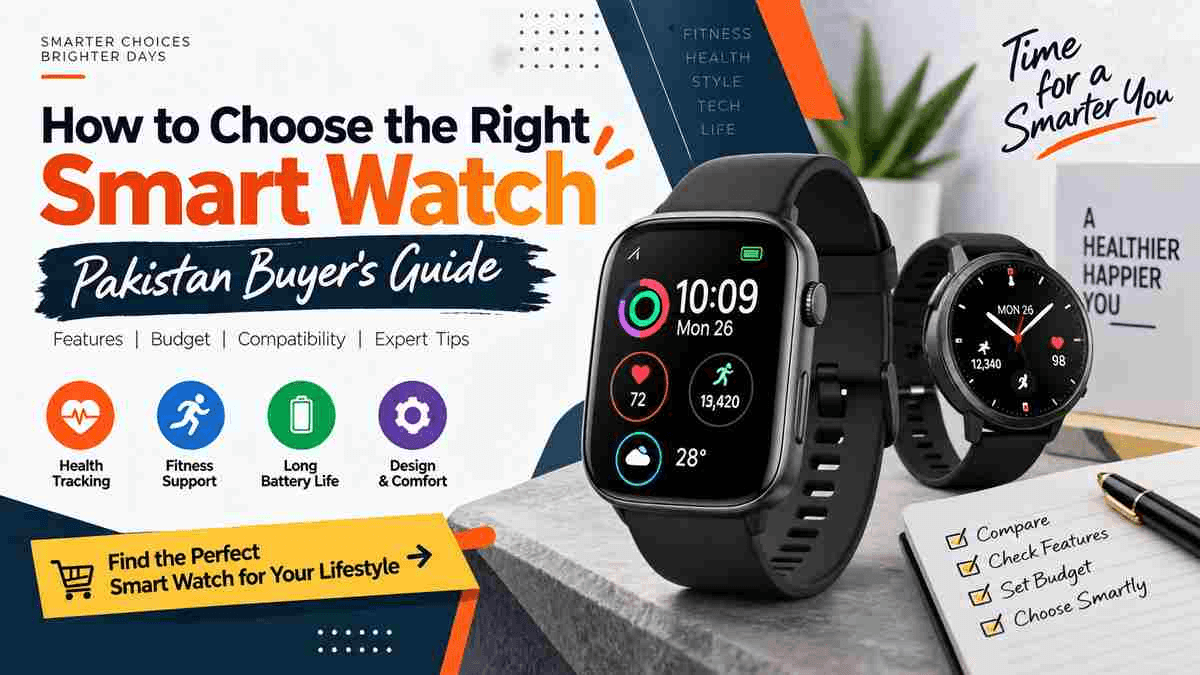
How to Choose the Right Smart Watch: Pakistan Buyer’s Guide
Go to Hall Road, or open Daraz for five minutes, and you’ll see the same photo repeated a hundred times — a shiny watch face, someone’s forearm, “Best Smart Watch 2026” written across the top. Half of these are decent. A good chunk aren’t. And you genuinely can’t tell which is which from a product photo alone, no matter how many stars it has.
That’s the real issue with buying a Right Smart Watch in Pakistan these days. Price doesn’t line up with quality the way you’d hope. A watch selling for Rs. 4,000 can outlast one twice its price, just because of who built the sensor inside or how the firmware was tuned. This guide is meant to cut through that guesswork.
Why Choosing the Right Smart Watch Matters in Pakistan:
A few years back, Right Smart Watches here were mostly a novelty — buy one, get notifications, feel a bit fancy. Not anymore. People now depend on them for fitness tracking, for answering calls mid-meeting without pulling their phone out, for tracking sleep, or honestly just to look a bit more put-together at the office.
But that popularity brought clones. Lots of them, priced almost identically to the real thing, sitting right next to legitimate options on the same shelf. You usually can’t spot the difference until the battery starts dying by 4 PM, or the screen goes unreadable the second you step into sunlight, or the “blood pressure sensor” spits out numbers that don’t mean much of anything. None of this is hard to avoid once you know what to look for — it just takes someone walking you through it the first time.
Types of Smart Watches Available in Pakistan:
Figuring out which type fits your life narrows the search fast. There’s no point comparing a kids’ watch to a fitness-focused one.
- AMOLED display watches: Sharper colors, deeper blacks, and genuinely better visibility once you’re outside in daylight — models like the HK9 Pro Max Plus fall in this category.
- Bluetooth calling watches: For people who’d rather answer a call from their wrist than dig through a bag — the WS Z9 Smart Watch is a common pick here.
- Fitness and health-tracking watches: Built for people who actually train and want heart rate, sleep, and step data over weeks — the YOLO TAG AI Smartwatch leans into this with its AI-based tracking.
- Kids’ smartwatches: Simplified interface, tougher build, usually tied to a parental app — worth pairing with something from our mobile accessories range if you’re setting one up for a child.
- Budget vs premium tier watches: Budget options like the Dany GW-05 or Haino Teko SQ-18 cover the basics fine, while premium tiers add smoother processors and better materials.
Key Factors to Consider Before Buying a Smart Watch:
Battery Life You Can Actually Rely On:
Nobody wants to charge a watch every night — that gets old fast. Five to seven days under normal use is a fair minimum to aim for. Anything under two days? That’s usually a sign it’ll end up in a drawer within a month, simply because charging it daily stops feeling worth it.
Display Type: AMOLED vs HD IPS vs TFT:
AMOLED holds up far better in direct sun, and given how bright most of the year gets here, that matters more than people expect. HD IPS is a reasonable middle ground if AMOLED pushes past budget. TFT screens, though — those tend to wash out outdoors. Fine indoors. Not great if you’re commuting or working outside for stretches of the day.
Build Quality and Strap Material:
Metal or reinforced frames simply outlast thin plastic once you’re wearing something daily — tossing it in a bag, knocking it against a doorframe, that kind of everyday wear. Straps matter too. Silicone deals with sweat and summer heat far better than leather, which tends to crack or start smelling after a few months.
Water and Dust Resistance (IP Rating Explained):
IP67 or IP68 usually means the watch survives splashes, sweat, and the odd rain shower. It doesn’t automatically mean you can swim with it — unless the listing specifically says 5ATM, treat “water resistant” and “waterproof” as two different promises entirely.
Bluetooth Calling: Worth It or Not?
Depends entirely on your day. If you’re often away from your phone — cooking, driving, walking somewhere — it’s genuinely convenient. But quality swings a lot between models. Some cheaper watches pack in weak mics that make your voice sound distant, almost robotic, on the other end.
Health Tracking Accuracy: What’s Real vs Marketing
Worth being upfront here: most consumer smartwatches use optical sensors that can get thrown off by skin tone, wrist movement, or even how tight the strap is. Heart rate and blood pressure readings tend to be useful for spotting patterns — say, noticing your resting heart rate creeping up over a few weeks — but they’re not medical-grade numbers, and they shouldn’t be treated as such. If health monitoring is a real concern, a proper device or a doctor’s opinion still wins.
Must-Have vs Nice-to-Have vs Skip-It Features
- Must-have: Solid battery life, a display readable outdoors, and at least IP67 water resistance for daily comfort.
- Nice-to-have: Built-in GPS and a handful of sport modes, mainly for runners and cyclists who go out without their phone.
- Often skippable: Any watch bragging about 100+ sport modes — most people realistically use two or three, max.
- Worth questioning: Budget watches claiming “medical-grade” ECG or blood pressure accuracy. That combination rarely checks out.
- Genuinely useful for most people: Smart notification management, which quietly cuts down how often you’re reaching for your phone.
Smart Watch Price Ranges in Pakistan
Budget Tier (Under Rs. 6,000)
Covers the essentials reasonably well — step counting, basic notifications, a few watch face options. The Dany GW-05 Smartwatch and Haino Teko SQ-18 Smart Watch are good reference points for what this tier typically offers.
Mid-Range Tier (Rs. 6,000 to 15,000)
This is where most buyers here land, and honestly, it’s probably where you should start looking too. Watches like the WS Z9 Smart Watch sit comfortably here, offering AMOLED displays and stable Bluetooth calling without paying for extras you’ll never touch.
Premium Tier (Rs. 15,000 and Above)
Stronger chipsets, smoother software, better-finished materials. The HK9 Pro Max Plus is a solid example of what this tier brings — nice extras like better sensors, though not essential for most people buying their first watch.
How to Choose Based on Your Lifestyle:
- Students: A budget or mid-range watch with decent notifications and solid battery life covers everything needed, without eating into a tight budget.
- Office professionals: Bluetooth calling and a clean, professional look matter more here than deep fitness tracking.
- Fitness enthusiasts: Built-in GPS and better heart rate accuracy make the jump to mid-to-premium worth it.
- Seniors: A bigger, easier-to-read display and a simple interface beat a watch loaded with features nobody will touch.
- Parents buying for kids: Parental controls and a genuinely tough strap matter more than any flashy extra a child won’t care about.
iPhone vs Android Compatibility: What to Check First
If you’re on iPhone, the choice is simple — Apple Watches only pair with iPhones, no way around it. Android gives you far more room to choose, though Samsung watches generally work best when paired specifically with Samsung phones, even if they technically connect to other Android brands too. Before buying anything, check which companion app the watch uses and glance at its rating on the Play Store or App Store. A badly-reviewed app can ruin an otherwise good watch. And while you’re at it, our earbuds collection covers a similar budget-to-premium spread if you’re building out a full wireless setup.
Common Mistakes Pakistani Buyers Make:
- Judging a watch purely by its interface: A polished-looking watch face says nothing about actual sensor accuracy or hardware durability.
- Trusting vague specifications: “Long battery life” without an actual number is usually hiding a weaker spec than they’d like you to notice.
- Ignoring app compatibility: Some imported watches sync only with obscure apps that don’t get along with newer Android versions, leading to constant dropped connections.
- Overpaying for features you’ll never touch: Paying extra for 100+ sport modes rarely makes sense if you’ll genuinely use two or three.
- Skipping the water resistance check: Assuming a watch handles water without confirming its actual IP rating is one of the quickest ways to kill a device.
Step-by-Step: How to Choose Your Smart Watch
- Decide your main use case first — fitness, everyday productivity, or basic connectivity — since that one decision shapes everything after it.
- Set a budget tied to features you’ll actually use, not the ones that just sound impressive in the listing.
- Confirm it’s fully compatible with your phone’s operating system before committing to anything.
- Compare battery life and water resistance side by side across your shortlist.
- Look specifically for reviews from Pakistani buyers, since climate and daily habits here can differ quite a bit from international reviews.
Quick Buying Checklist
- Confirm the battery lasts at least 5 days under normal, everyday use.
- Check the actual IP rating instead of assuming any water resistance.
- Verify phone compatibility before you unbox anything.
- Compare Bluetooth calling quality if that feature matters to your routine.
- Read verified customer reviews rather than trusting product photos alone.
Final Verdict:
There’s no single “best” smart watch that suits everyone — it comes down to your budget, how you’ll actually use it, and which phone is in your pocket. Start with battery life, display quality, and water resistance. Narrow from there based on how you actually live. Do that, and you’ll end up with a watch you’re still wearing six months later, not one quietly gathering dust in a drawer.
Frequently Asked Questions
1. What is the best battery life for a Right Smart Watch in Pakistan’s climate?
Five to seven days under normal use gives enough of a buffer that you’re not constantly chasing a charger.
2. Are cheap smartwatches under Rs. 5,000 worth buying?
They can work fine for basic notifications and step tracking, though battery life and build quality tend to swing a lot more than mid-range options.
3. Do smartwatches accurately track blood pressure?
Most consumer models give rough estimates rather than medical-grade accuracy — better for spotting trends than for making health decisions.
4. Is Bluetooth calling necessary in a smart watch?
It’s genuinely handy if you’re often away from your phone, but not essential if your phone is usually within reach anyway.
5. Which is better for Android users — a Samsung watch or a third-party brand?
Samsung watches tend to work best specifically with Samsung phones, while third-party brands often give you more flexible compatibility across different Android devices, usually at a friendlier price.