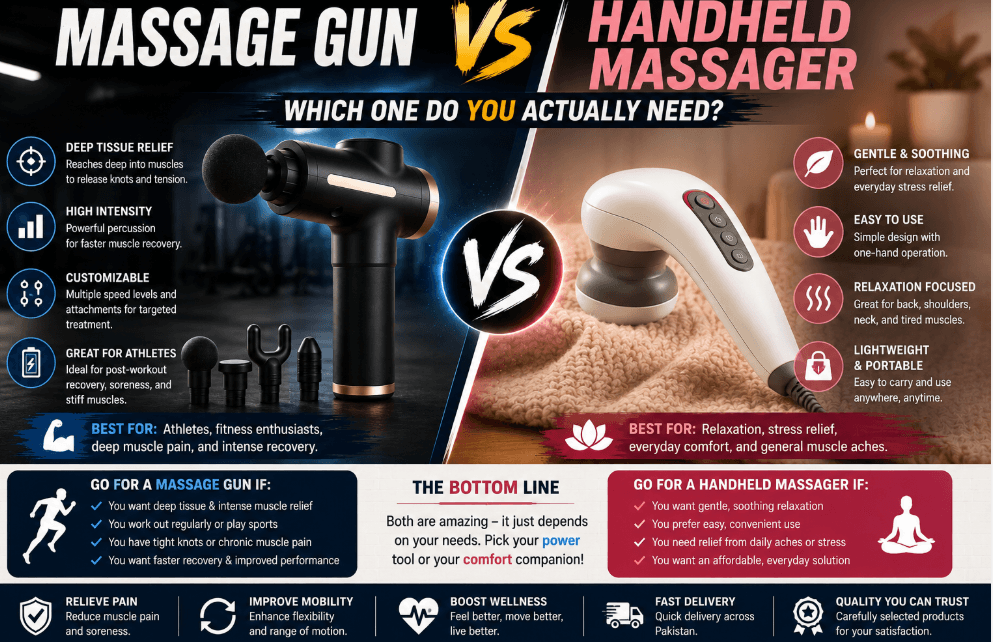
Massage Gun vs Handheld Massager: Which One Do You Actually Need?
Reviewed by the KunShop Product Research Team. Last updated: August 2026.
Quick answer: Massage guns hit muscles with fast, deep pulses (that’s percussive therapy), and they’re usually the better pick after a workout or when you’ve got a stubborn knot. Handheld massagers work with a softer surface vibration instead — think everyday relaxation, sensitive muscles, or an older relative who doesn’t want anything too intense. Train regularly? A massage gun is probably worth the money. Just want something for daily comfort? A handheld massager gets the job done for less, and it’s quieter too.
Disclaimer: This article is for general informational purposes only and isn’t a substitute for professional medical advice. Neither device treats injuries, chronic pain, or underlying medical conditions. Got an injury, a circulation or clotting condition, or are you pregnant? Talk to a doctor or physiotherapist before trying either device.
Sore shoulders after a long day at a desk. Tight calves after a five-a-side match at your local ground. A stiff neck from scrolling your phone in bed before sleep. Sound familiar? If you’ve spent any time browsing massage device listings online, torn between a massage gun and a regular handheld massager, you’re nowhere near alone in that confusion. Walk into an electronics bazaar in Karachi, or scroll through a marketplace app late at night, and you’ll find both devices sitting side by side — both promising “instant pain relief,” both looking like they belong in a toolbox rather than a spa.
So which one actually suits you? Let’s get into it.
Massage Gun vs Handheld Massager: At a Glance
| Massage Gun | Handheld Massager | |
|---|---|---|
| Mechanism | Percussion (piston-driven pulses) | Vibration (off-centre spinning weight) |
| Muscle penetration | Generally deeper than vibration-only devices; exact depth varies by model | Mostly surface-level |
| Intensity | Higher, usually adjustable | Gentler, usually adjustable |
| Often used for | Muscle knots, post-workout tightness | Daily relaxation, sensitive users, elders |
| Noise level | Moderate to loud on cheaper models | Generally quieter |
| Comfort for extended use | Can feel heavy in hand after 10+ minutes | Often lighter, easier to hold longer |
| Price in Pakistan (approx., Aug 2026) | Roughly PKR 3,000–20,000+ | Roughly PKR 1,500–4,000 |
A quick word on that “muscle penetration” row: some manufacturers throw around figures like 10–16mm for their more powerful models, but there’s no industry-wide standard for measuring this. It really comes down to which head attachment you’re using, how much pressure you apply, and even how your own tissue responds. Treat those depth numbers as marketing figures, not lab measurements.
What Is a Massage Gun?
You’ve probably seen one of these — the jackhammer-looking device gym trainers and physios keep reaching for. It runs on percussive therapy: short, rapid pulses that dig into the muscle tissue instead of just gliding across the skin.
How Does a Massage Gun Work?
A motor inside drives a piston back and forth, pushing the attached head into your muscle again and again. Most manufacturers advertise somewhere between roughly 1,500 and 3,200 pulses per minute, but that number is model-specific, so check the actual spec sheet rather than assuming. There’s some real research behind this, too — one study using infrared imaging and tissue-oxygenation sensors found that a short, standardized percussive session raised local skin temperature, deep tissue blood flow, and muscle oxygenation in healthy adults. A separate study looking at hamstring flexibility found a short-term boost in range of motion after just one session. Worth being clear about what this actually means, though: these are short-term effects measured in a controlled setting, not a promise that you’ll get the exact same result.
What Is a Handheld Massager?
This is the older, broader category — the classic wand or hammer-style device that’s probably sitting in a drawer somewhere in half the households in Pakistan already. It leans on vibration rather than deep percussion.
How Does a Handheld Massager Work?
Instead of a piston punching in and out, you’ve got a spinning motor with an off-centre weight that creates vibration across whatever surface it touches. Some models throw in kneading rollers or heat as well. The overall feeling is softer — more of a buzz than a pound — which is exactly why a lot of people, especially older users, tend to reach for these first.
Massage Gun vs Handheld Massager: Key Differences
Most people go wrong by treating these as the same thing with different price tags. They’re not. Here’s where they actually split:
- Power & Intensity: Massage guns hit harder and more precisely; handheld massagers stay on the surface. Got a stubborn, localized knot? The gun usually wins here.
- Muscle Penetration Depth: Massage guns are generally thought to reach deeper into the muscle, especially the higher-end ones — though again, the exact numbers vary and there’s no standard measurement across brands. Handheld massagers mostly stay on the surface layer, which is fine for relaxing but not ideal for deep tissue work.
- Portability & Ease of Use: Handheld massagers are often lighter and easier to hold through a longer session. A massage gun can start to feel heavy in your hand after ten minutes or so, especially the stronger models.
- Noise Level: Handheld massagers tend to run quieter. Cheaper massage guns, on the other hand, can get loud enough to matter if someone’s asleep in the next room.
- Price: Entry-level options in both categories often land in a similar price bracket in Pakistan, but a premium massage gun with a strong motor and long battery life will usually cost more than a premium handheld massager.
- Best Use Cases: Athletes and gym-goers tend to reach for massage guns after training. Handheld massagers suit general relaxation, older family members, and everyday stress relief better.
Massage Gun vs Electric Massager: Is There a Real Difference?
Here’s the thing — a massage gun is technically just a type of electric massager. It’s the more intense, more targeted branch of a bigger family, and a handheld massager is another branch of that same family. So when someone searches “electric body massager vs massage gun,” what they’re really asking is whether they need something gentle and general-purpose, or something more powerful and specific. Mostly dealing with everyday stiffness? A general-purpose electric massager probably covers you. Chasing post-workout soreness specifically? That’s when the more targeted device starts to make sense.
Benefits of Using a Massage Gun
-
Muscle Recovery:
A lot of athletes build massage guns into their recovery routine, but here’s what the research actually shows: a study in the Journal of Athletic Training tested a 5-minute massage gun session against passive rest in 65 active adults, and the results were mixed — the researchers themselves said more work is needed to understand what’s actually happening physiologically. So it’s fair to treat a massage gun as one possible piece of a recovery routine, not a proven shortcut to bouncing back faster.
-
Sore Muscles:
A few minutes of percussive work on tired legs or arms is commonly reported to loosen things up, though how much it helps really does vary from person to person.
-
Back Pain:
Lower back tightness from sitting all day can respond well to moderate-speed percussion, particularly around the lower lumbar and upper glute area. Just steer clear of the spine itself.
-
Neck and Shoulder Pain:
Tight shoulder blades from a desk job are probably the single most common reason people reach for one of these. But the neck itself is off-limits — front, sides, back, and the upper spine all included. That area sits close to major blood vessels and nerve structures near the surface, so percussive pressure there is a genuine risk, not just an abundance of caution. If your neck actually needs attention, switch to a handheld massager on a low setting and stick with gentle vibration instead. You can still use a massage gun on the trapezius — the flat muscle across the top of your shoulders — as long as you stay well clear of the neck, use the lowest speed, and pick a soft attachment.
Benefits of Using a Handheld Massager
Relaxation:
If you’re trying to wind down after a long day rather than fix something specific, the gentler vibration of a handheld massager is usually more pleasant to sit with for longer stretches.
- Body Pain: For the general aches that come from standing all day or sleeping in an awkward position, a handheld massager helps without feeling too intense.
- Back Pain: A lot of handheld models come with a curved shape built specifically to reach your own back without needing another person’s help — handy if you live alone.
Which May Be More Suitable for Back Pain, Neck Pain, and Recovery?
- Back pain: Both can help. Massage guns tend to be better for actual knots, handheld massagers for general daily tightness.
- Neck pain: Keep it gentle no matter what device you’re using — a handheld massager on low intensity, or, if you’re careful, a massage gun with a soft round attachment on the lowest speed, staying well away from the spine and throat.
- Muscle recovery: Research leans toward massage guns here, though how much they actually speed things up is still an open question.
- Everyday relaxation: Handheld massagers are simply more comfortable to sit with for a longer, casual session.
Are Massage Guns and Handheld Massagers Actually Effective?
Short answer: there’s real evidence behind the short-term effects. Studies have measured increases in local blood flow, muscle oxygenation, and range of motion after percussive massage sessions. That doesn’t mean everyone gets identical results, and it definitely doesn’t mean either device replaces medical treatment. Dealing with an injury, a herniated disc, or chronic nerve pain? See a doctor or physiotherapist instead of reaching for either device.
When to Use Which:
A massage gun fits naturally before or after a workout, or on one specific tight spot that’s bothering you. A handheld massager works better during downtime, in the evening, or whenever you just want general comfort without much intensity behind it.
How to Use a Massage Gun Correctly:
Start on the lowest speed — always. Hover the head over the muscle instead of pressing hard; let the device do the work rather than forcing it. Move slowly, about 15–30 seconds per area, and never apply it directly onto a joint, bone, or the spine.
How often? Check your specific device’s manual first — session length and frequency guidance really does vary depending on the model and motor strength. As a rough starting point, a lot of devices suggest short one-to-two-minute sessions per muscle group instead of camping out on one spot. Not sure what’s right for you? A physiotherapist can tell you.
Safety notes: Stay off the spine, the throat, and anywhere with a fresh injury. If you’re on blood thinners or have a clotting condition, skip it — and if you’re pregnant, check with a doctor first.
How to Use a Handheld Massager Correctly:
Glide it gently across the muscle rather than pushing down hard. These are generally the gentler category of the two, but that doesn’t mean zero caution is needed — avoid excessive pressure or lingering too long on one spot.
Safety notes: Follow your device’s recommended session length rather than guessing — check the manual, since this changes by model and motor strength. Steer clear of open wounds or swelling, and follow the manufacturer’s charging instructions like you would with any electronic device.
How Much Do They Cost in Pakistan?
The numbers below are approximate, based on what’s been seen at the time of writing, and prices do shift — always double-check current listings before buying.
- Massage guns: Budget models usually start around PKR 3,000–6,000. Mid-range deep tissue models sit around PKR 8,000–15,000, and premium options with app connectivity and stronger motors can go past PKR 20,000.
- Handheld massagers: Generally the more affordable option, starting around PKR 1,500 and going up to roughly PKR 4,000 depending on brand, heat function, and attachments.
- Electric massager (the umbrella term): Since this label covers both categories above, the price range spans the whole spectrum — roughly PKR 1,500 to 20,000+, depending on which type and feature set you end up choosing.
Buying local has its perks — warranty support, faster delivery, Cash on Delivery — and it’s worth weighing those against whatever an overseas seller is offering, listing by listing. You can browse current options in kunshop.pk’s massagers category before deciding.
Best Picks in Pakistan:
Best massage gun for home use: A massage gun general home use, look for adjustable speed settings, a few interchangeable heads, and battery life that matches how often you’ll actually use it. You probably don’t need a gym-trainer-grade device just to cover your back, shoulders, calves, and thighs.
Best handheld massager for home use: A handheld massager rechargeable option with a curved neck attachment tends to work well at home, especially if you’re buying for an older family member who wants something gentler. Prioritise a comfortable grip and quiet operation over raw power.
You can browse the current massage gun range and handheld massager range on kunshop.pk and compare a few models side by side.
Quick Decision Guide: Which One Fits You?
Go with a massage gun if you train regularly, deal with recurring muscle tightness, or want something that might support your post-workout recovery.
Go with a handheld massager if relaxation is really the goal, your muscles are sensitive, or you’re shopping for an older family member who’d prefer something gentler.
Frequently Asked Questions
Is a massage gun better than a handheld massager?
Not really a fair comparison — it depends entirely on what you’re trying to do. Massage guns suit deep muscle tightness and post-workout use better; handheld massagers are the better fit for gentle, everyday relaxation.
Can I use a massage gun every day?
Check your device’s manual first, since this varies by model. As a general pattern, many healthy adults do use short daily sessions on a given muscle group, avoiding anything injured or inflamed — but that’s not a hard rule, and if you have an existing medical condition, check with a doctor before making it a habit.
Which is better for back pain — massage gun or handheld massager?
For actual knots and tightness, a massage gun is usually the stronger pick. For general daily back discomfort, a handheld massager often does the job just fine and is more comfortable for longer use.
Are massage guns safe for beginners?
Used correctly — lowest speed, avoiding bone, joints, and the spine — yes, they’re generally considered safe for healthy adults. If you have an existing injury, a circulation issue, or any medical condition, check with a doctor first.
Can a massage gun cause bruising or damage?
It can, if you’re using it wrong — pressing too hard, sitting on bone, or applying it over an existing injury. Used properly on soft muscle tissue at a moderate setting, it’s generally lower-risk for healthy adults, but it still deserves some care.
Final Thoughts
There’s no single “winner” here — it really comes down to what your body needs and how you’re planning to use the thing. Dealing with post-workout tightness or knots that keep coming back? A massage gun is probably worth the investment. Mostly after everyday comfort, especially something the whole family can share? A handheld massager gets you there for less money and a lot less noise.
Whichever way you lean, buy from somewhere that actually stands behind the product with real warranty and support terms. Browse the full massager collection on kunshop.pk, compare a couple of models side by side, and pick based on how you’ll actually use it — not just the spec sheet.