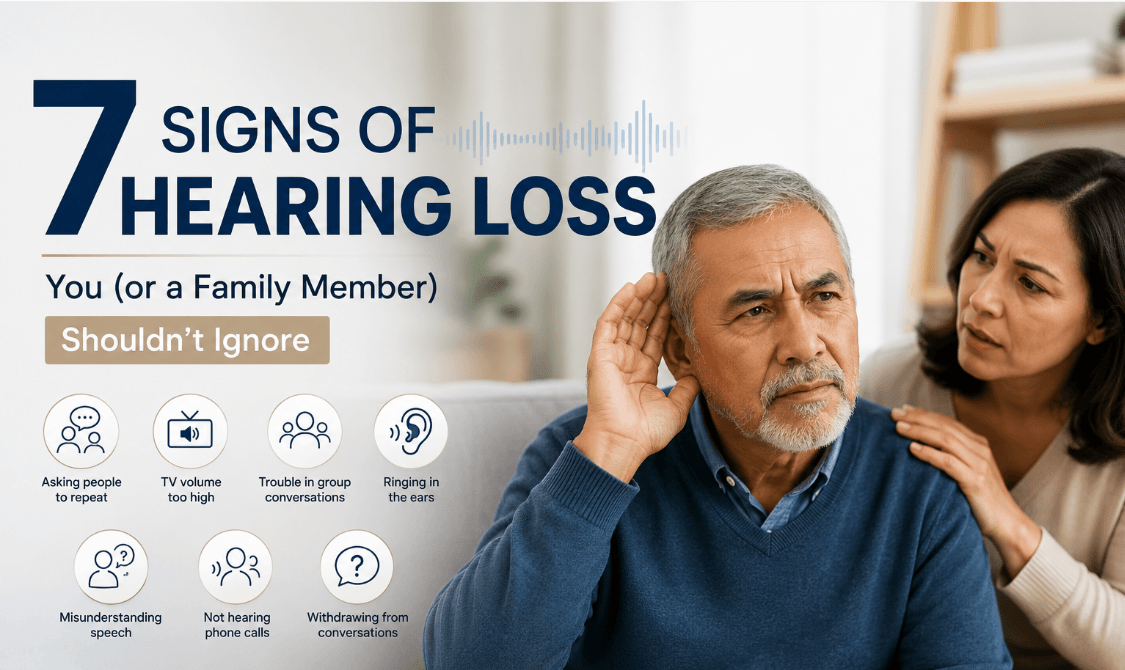
7 Signs of Hearing Loss You (or a Family Member) Shouldn’t Ignore
Written by the KunShop Health & Wellness Editorial Team. Last updated: August 2026.
“Never mind, it wasn’t important.” You’ve heard that one before, probably more than once, right after asking someone to repeat themselves for the third time. Or maybe it’s your dad — sitting closer to the TV than he used to, remote in hand, volume at a level that makes everyone else wince a little. Hearing loss doesn’t announce itself. It just… shows up, slowly, in pieces, until one day it’s not subtle anymore.
Quick answer: The most common early signs of hearing loss are asking people to repeat themselves often, turning up the TV or phone volume more than others need to, struggling to follow conversations in noisy places, relying on lip-reading without noticing, and family members mentioning it before you do. If two or more of these sound familiar, it’s worth getting a hearing test rather than waiting it out.
This guide covers the seven signs that actually matter, how they show up differently in elderly parents, what causes hearing loss, and what to do once you’ve noticed it.
Why Hearing Loss Is Easy to Miss at First?
Weird thing about early hearing loss — it doesn’t feel like hearing loss. It feels like everyone around you got lazy with their diction. Or restaurants got louder. Or your phone speaker went bad. The brain is annoyingly good at covering for what it’s missing, filling in blanks without asking permission first, which is exactly why early signs get explained away for months. Sometimes years.
No dramatic moment where it announces itself. Just small adjustments stacking up — volume up a notch here, leaning in a bit there, one more “what?” than usual — until it’s obvious, and you’re left wondering how long this has actually been going on without you noticing.
7 Signs of Hearing Loss to Watch For:
1. You Keep Asking People to Repeat Themselves:
Why do I keep asking people to repeat themselves — if that thought’s crossed your mind, this is usually the starting point. People haven’t gotten worse at talking. What’s happening is the sharper consonant sounds, “s” and “f” mainly, start fading first. Those are the sounds that keep speech sounding crisp instead of mushy. Lose them and everyone just sounds a bit… slurred.
2. The TV or Phone Volume Keeps Creeping Up:
Does turning up the TV mean hearing loss? Not on its own. But when it’s a pattern — when family keeps saying it’s too loud, every time, not just once — that’s worth paying attention to. Phone calls tend to follow right behind.
3. Conversations in Noisy Places Are Getting Harder:
Weddings. Restaurants. A living room full of relatives all talking over each other. Anywhere with competing noise tends to expose hearing loss way before quiet one-on-one chats do. Difficulty hearing conversations specifically in loud rooms, while doing fine with one person in a quiet space, is one of the more telling signs here. Also the easiest one to explain away. “It was just loud in there” is such a convenient excuse.
4. You’re Relying on Lip-Reading Without Realizing It:
This one creeps up more than any other on the list. Needing to look right at whoever’s talking — sometimes without even clocking that you’re doing it — because your brain quietly started leaning on visual cues instead of pure audio. Ask around. A lot of people didn’t notice they’d picked up this habit until somebody else pointed it out to them.
5. Phone Calls Feel More Difficult Than They Used To:
No lips to read. No face to watch. Just sound, stripped bare of everything that normally helps fill gaps. That’s why phone calls tend to expose hearing loss early, often before it’s obvious in person at all.
6. You’re Withdrawing From Conversations and Social Situations:
Doesn’t look like a hearing problem from the outside. Looks like someone getting quieter. Skipping outings they used to actually enjoy. Seeming more drained after gatherings than makes sense. Straining to follow conversation for hours is genuinely exhausting, more than people give it credit for, and pulling back becomes the easier option.
7. Family Members Have Mentioned It Before You Noticed:
Sometimes the clearest sign isn’t something you catch in yourself at all. A family member losing their hearing often doesn’t clock it themselves — the people around them notice first. If more than one person’s brought it up, separately, more than once, that’s not something to laugh off anymore.
The Main Types of Hearing Loss:
Not all hearing loss is the same, and knowing the general category can help a conversation with a doctor go faster.
- Conductive hearing loss: Sound has trouble physically reaching the inner ear — often caused by earwax buildup, fluid, or an ear infection. Frequently temporary and treatable.
- Sensorineural hearing loss: Damage to the inner ear or the hearing nerve itself, usually from aging or long-term noise exposure. This is the most common type and is typically permanent, though it’s very manageable with the right device.
- Mixed hearing loss: A combination of both — part treatable, part permanent.
An audiologist’s test is what actually tells you which one you’re dealing with, so guessing isn’t worth it either way.
Signs of Hearing Loss in Elderly Parents:
Signs of hearing loss in elderly parents look a bit different than they do in younger adults, mostly because families lump it in with “getting older” without digging further. Watching for age-related hearing loss symptoms specifically, instead of treating it as just a general aging thing, actually makes a real difference in catching it early enough to matter.
A few things worth watching for if you’re trying to figure out how to tell if a parent is losing their hearing:
- TV volume: consistently loud for everyone else, and it’s gotten worse over the last year or two rather than just being a longstanding preference
- Phone avoidance: letting calls ring out more than they used to, or passing the phone off the second it rings
- Repeated questions: the same question twice in one conversation, sometimes minutes apart, no sign they’ve noticed the repeat
- Social pullback: skipping things they’d normally show up for, or sitting quietly at the edges instead of joining in like before
- Delayed responses: a beat too long before answering, especially when several people are talking at once
Age-related hearing loss is genuinely common. According to the National Institute on Deafness and Other Communication Disorders (NIDCD), about one in three adults between 65 and 74 has some degree of hearing loss, and that rises to nearly half of adults over 75 — which is exactly why it gets normalized instead of dealt with. If these signs sound familiar, it’s worth an actual conversation. Turning the TV down for them every visit isn’t a fix, it’s just avoidance dressed up as helpfulness.
How Hearing Loss Is Actually Diagnosed:
Worth knowing what a hearing test actually involves, since a lot of people put it off simply because they don’t know what to expect. It’s a lot less clinical than most assume, honestly.
Usually starts with a short conversation — noise exposure history, family history, whatever medications you’re on. Then an audiologist runs a pure-tone test: quiet booth, headphones, you respond whenever you catch a beep at different pitches and volumes. Twenty, thirty minutes, tops. Not uncomfortable in the slightest.
Results land on something called an audiogram, basically a map of which frequencies you’re missing, and by how much. The same chart is used to decide whether a hearing aid makes sense, and how it should be programmed if it does. A lot of clinics also run a speech-in-noise test, which mimics the restaurant scenario far better than pure tones ever could — usually the part where people go “oh, that’s exactly it.” If you’ve got one scheduled, our guide on preparing for a hearing test covers what to bring and what to expect, so there’s nothing left to guess.
What Causes Hearing Loss?
Hearing loss causes fall into a handful of buckets, and most people dealing with it are actually facing some overlap rather than one clean cause.
Age tops the list, by far. The tiny hair cells inside the inner ear wear down over decades, and once they’re gone, they’re gone — there’s no repair mechanism, unlike skin or a lot of other tissue. Loud noise exposure speeds that process up considerably, whether that’s factory work for years, standing near traffic constantly, or headphones cranked louder than they should’ve ever been.
Genetics matter more than people assume and are worth mentioning to a doctor even before symptoms show up, if it runs in the family. Certain illnesses and infections can damage hearing, sometimes permanently. A handful of medications carry it as a side effect too, particularly certain antibiotics and chemotherapy drugs, though that’s fairly rare in practice. And then there’s the cause that trips people up constantly because it feels too simple to be real: earwax buildup. Sounds almost silly. Accounts for more cases of “hearing problems” than you’d expect.
Can Hearing Loss Get Worse If Left Untreated?
Usually, yes. Untreated hearing loss symptoms don’t tend to sit still — they tend to progress, often slowly enough that you don’t notice the shift year to year until you look back and realize how much has actually changed. Can hearing loss happen gradually? Almost always. Sudden hearing loss exists, but it’s genuinely the exception, and it usually comes with enough other warning signs that people end up at a doctor fast anyway.
Whether it’s reversible depends heavily on the cause, and this is where people get their hopes up for no reason sometimes. Earwax buildup and certain infections are often fixable, sometimes in a single visit. Age-related and noise-induced hearing loss, though, is typically permanent once it’s set in, even if it can be managed well with the right device.
Even mild hearing loss symptoms deserve attention early. Research from Johns Hopkins Medicine has linked untreated hearing loss to a higher risk of social isolation and faster cognitive decline, likely because straining to hear takes a real toll on the brain over time and often leads people to withdraw from the conversations that keep them mentally engaged. Not a minor inconvenience, in other words.
When Should You Get a Hearing Test?
When to get a hearing test — fair question, and honestly, the answer is sooner than most people think to ask it. A few situations that should push you toward a test instead of another few months of “let’s just see”:
- Persistent volume creep: family repeatedly saying the TV or phone’s too loud, and it’s turned into a running joke rather than a one-off comment
- Noisy-room struggle: group conversations or restaurants have become a real strain, not just mildly irritating background noise
- Repeated repeat-me’s: asking people to repeat themselves has become close to daily, not occasional
- Social withdrawal: skipping gatherings that used to be genuinely enjoyable, without a clear reason why
- A gut feeling: if you’re reading this far down the page and wondering, honestly, that’s reason enough
Signs you need a hearing aid usually overlap heavily with this list. If a few of these feel familiar, a proper hearing test is the actual next move, not six more months of waiting to see if it sorts itself out, because it usually doesn’t.
Frequently Asked Questions:
What are the first signs of hearing loss?
Asking people to repeat themselves, cranking the TV or phone volume, and struggling with conversation in noisy places are usually the earliest and most noticeable signs.
How do I know if I’m losing my hearing?
Consistently missing words, relying more on lip-reading than you used to, and family bringing it up more than once are all worth a hearing test instead of guessing.
Can hearing loss happen gradually?
Yes, and by far the most common pattern. It develops over years, which is exactly why it’s so easy to miss until it’s fairly far along.
How can I tell if my parent has hearing loss?
High TV volume as a habit, avoided phone calls, repeated questions mid-conversation, and pulling back from things they used to genuinely enjoy are the clearest signals.
Is hearing loss reversible?
It depends on the cause. Hearing loss from earwax buildup or certain infections is often treatable. Age-related and noise-induced hearing loss is usually permanent, though it can be managed well with the right device.
What to Do Next If You Recognize These Signs:
If any of this hit close to home, for you or a parent, the next move is simple, at least on paper: get it checked instead of sitting with the not-knowing for another year. How to know if you have hearing loss for sure really just comes down to a proper test, and it takes far less time than people brace themselves for.
In the meantime, kunshop.pk carries a range of hearing amplifiers and support devices for different needs, from occasional situational use to daily support for elderly parents. Not sure which fits? Our guide on sound amplifier vs hearing aid differences breaks down exactly when each one makes sense, and if it’s a parent you’re worried about specifically, choosing a hearing device for elderly parents is worth reading before buying anything. Leaning toward a full hearing aid instead of an amplifier? Our hearing aid buying guide covers what to look for, including BTE vs in-ear hearing aids and how to clean and maintain your hearing aid once you’ve got one. kunshop.pk ships across major Pakistani cities with cash on delivery, so trying something out doesn’t have to turn into an ordeal, and for a lot of families, it ends up being the easiest first step before ever booking a full audiologist visit.
Top Sellers
-
Sale!

Men’s Spider Hoodie
₨ 4,500Original price was: ₨ 4,500.₨ 2,899Current price is: ₨ 2,899. -
Sale!

Pack of 2 Men’s Sweatshirts
₨ 6,000Original price was: ₨ 6,000.₨ 3,499Current price is: ₨ 3,499. -
Sale!

Pack of 3 Men’s High Neck Sweaters
₨ 5,500Original price was: ₨ 5,500.₨ 3,499Current price is: ₨ 3,499. -
Sale!

Pack of 3 Men’s Round Neck Sweater
₨ 6,500Original price was: ₨ 6,500.₨ 4,800Current price is: ₨ 4,800. -
Men’s Round Neck Sweater
-
Sale!

Men’s Blue Sherpa Denim Jacket
₨ 8,000Original price was: ₨ 8,000.₨ 4,499Current price is: ₨ 4,499. -
Sale!

Pack of 2 Nike Plain Men’s Hoodies
₨ 6,700Original price was: ₨ 6,700.₨ 4,499Current price is: ₨ 4,499. -
Sale!

Nike Men’s Zipped Hoodie
₨ 3,500Original price was: ₨ 3,500.₨ 2,100Current price is: ₨ 2,100. -
Sale!

Men’s Oversized Hoodie
₨ 2,700Original price was: ₨ 2,700.₨ 1,999Current price is: ₨ 1,999. -
Sale!

Pack of 3 Men’s Zipper Hoodie
₨ 9,999Original price was: ₨ 9,999.₨ 6,999Current price is: ₨ 6,999. -
Sale!

Pack of 2 Basic Hoodies
₨ 8,000Original price was: ₨ 8,000.₨ 4,899Current price is: ₨ 4,899. -
Sale!

Apple Type C Handfree
₨ 1,999Original price was: ₨ 1,999.₨ 1,599Current price is: ₨ 1,599.