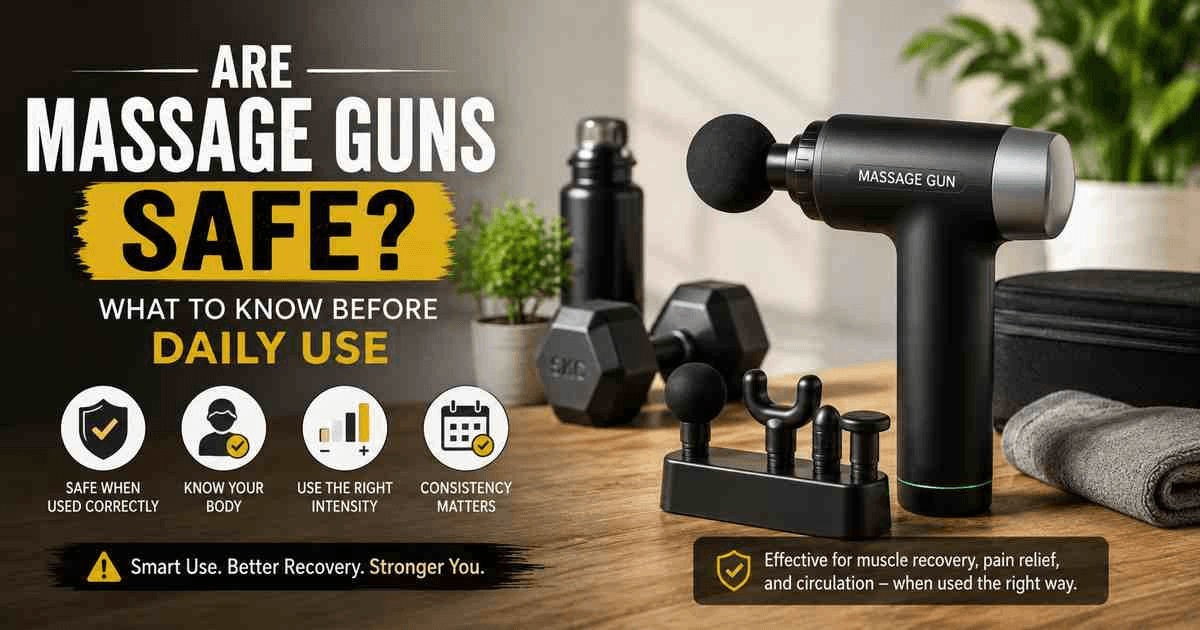
Are Massage Guns Safe? What to Know Before Daily Use
Reviewed by kunshop team | Updated August 2026
Quick answer: Yes — mostly. Massage guns safe for the majority of people, but “safe” here comes with conditions attached: right pressure, right duration, right spot on the body. Almost every problem traces back to one of three things — pushing too hard, staying too long in one place, or aiming the device somewhere it was never designed for (the neck and the eyes are the big two). Got an injury or a medical condition? Talk to a doctor first. It’s a five-minute conversation that can save you a much longer recovery.
Percussive massagers have quietly become one of the most-searched recovery tools in Pakistan over the past couple of years. Walk into any decent gym and someone’s using one. Physiotherapists have them in their clinics now too, and prices have dropped enough that ordinary people are picking up massage guns in Pakistan for home use rather than treating them as a luxury item. Fair enough, but here’s the question worth actually answering: are these things safe, or is that just something the marketing wants you to believe? Let’s get into the real picture — benefits, risks, how to use one properly, and where you genuinely shouldn’t.
How Massage Guns Actually Work
Strip away the branding and a massage gun is fairly simple. It’s a motor inside a handle, firing quick repeated pulses of pressure into muscle tissue — percussive therapy, if you want the technical term. Think of it as a stand-in for a deep tissue massage, minus the actual massage therapist standing over you. That rapid tapping is supposed to do a few things at once: get blood moving to the area, loosen up tight muscle fibers, and dull the pain signals your brain tends to associate with soreness.
It’s not the same as a vibration plate, and it’s definitely not the same as one of those cheap handheld vibrating massagers that just buzz. Those shake the whole area broadly. A massage gun, especially with the right attachment head, lets you go after one specific spot — a knot in your shoulder, say, or a calf that’s been tight since Sunday’s run.
Are Massage Guns Safe? The Honest Answer
For a healthy adult with no underlying condition, massage guns are considered safe — provided the technique is right. The device isn’t the villain. Misuse is: pushing too hard, staying on one muscle for ten minutes instead of two, or using the gun somewhere it has no business being, like the neck or the face. This isn’t just caution for caution’s sake — a 2021 case report documented a woman who developed rhabdomyolysis after an extended percussion session, and a 2026 BMJ Case Reports study described a man with torn retinas after months of using one near his eyes. Both rare. Both proof that placement matters more than power.
Massage Gun Benefits for Muscle Recovery
Before the list of what to avoid, it’s worth pausing on why people bother with these things in the first place. A decent massage gun for muscle recovery earns its place in a recovery routine for a few real reasons.
- Blood flow: the percussive motion stimulates circulation in the targeted muscle, which can help deliver the oxygen and nutrients that tissue needs while it’s repairing itself post-exercise.
- Muscle soreness relief: plenty of users notice a real drop in delayed-onset muscle soreness (DOMS) after using one following a hard workout.
- Flexibility and range of motion: loosen the muscle fibers first, and stretching afterward tends to go further, with movement feeling less locked-up.
- Everyday tension release: this isn’t only for athletes — a few minutes on tight shoulders after a long day at a desk does something too.
- A steadier recovery routine: used consistently, it may cut down the stiffness that builds up between training sessions, which in turn makes it easier to actually keep training.
Massage Gun Side Effects and Risks
No point pretending massage guns are risk-free — they’re not, though most of the downsides are minor and pass quickly. A percussion massage gun used carelessly can still cause its share of trouble.
Bruising and skin sensitivity top the list, almost always from too much pressure or too much time on one area. Some people get a tingling or numb feeling if the device lands directly over a nerve — temporary, but unpleasant. And as those two case reports show, pushing too hard for too long, or using the gun somewhere it should never go, can lead to something more serious. Both documented cases involved either an existing health vulnerability or repeated misuse near the eyes — not the kind of everyday mistake most users make. Still, the pattern holds: the risk scales with how carelessly the thing gets used, not with the device itself.
Where You Should Never Use a Massage Gun
Some parts of the body just aren’t built to take percussive pressure. Worth memorizing this list, honestly.
- The neck: nerves and blood vessels sit close to the surface here, which is why physiotherapists consistently name it as the number one area to stay away from.
- The eyes and face: the 2026 BMJ Case Reports case is a direct warning here — using a massage gun anywhere near the eyes risks real, potentially lasting retinal damage.
- Joints: knees, elbows, ankles — barely any soft tissue cushioning, so direct pressure just causes discomfort rather than relief.
- Varicose veins: the valves are already compromised, and intense pulsing on top of that won’t help.
- Broken skin, bruises, or fresh injuries: applying pressure to compromised skin or a recent injury tends to make things worse, not better.
Who Should Avoid Using a Massage Gun
Most healthy adults are fine to use one. A handful of groups should be more careful, or skip it altogether — people who are pregnant, anyone with a bleeding or clotting disorder, and those managing an untreated chronic condition like diabetes or kidney disease should check with a healthcare professional first. Same goes for anyone with an unhealed injury, a recent surgery, or pain they can’t explain. A massage gun helps with recovery. It’s not a diagnostic tool, and it shouldn’t be the first thing reached for when something hurts and you don’t know why. If you’re still weighing whether a percussive device is even the right fit for you, our Massage Gun vs Handheld Massager: Which One Do You Actually Need? comparison breaks down which one suits gentler, lower-risk use.
Can You Use a Massage Gun Every Day?
For most healthy people, yes — daily use in short sessions is generally fine with a massage gun for daily recovery. The word doing the heavy lifting there is “short.” This isn’t a device meant for long, uninterrupted sessions on the same muscle, day after day.
A sensible routine looks like one to two minutes per muscle group, once or twice daily, rather than one marathon session. Muscles need actual recovery time between uses, and giving the same spot a break every few days helps avoid the skin and tissue irritation that comes with overdoing it. Notice ongoing soreness or redness somewhere you’ve been targeting a lot? That’s your cue to back off.
Massage Gun Before or After a Workout?
Both timings have their place, and it really comes down to what you’re trying to achieve for muscle recovery after exercise. Before a workout — 30 seconds to a minute per muscle group — a massage gun can warm up tissue and improve mobility, working alongside dynamic stretching rather than replacing it. After a workout, a slightly longer session on the muscles you just worked keeps blood flow going and helps cut down next-day stiffness. Neither one is objectively better; it depends on whether the goal is prepping a muscle for effort or helping it recover afterward.
How to Use a Massage Gun Safely
Good technique is really what separates a useful handheld massage gun from one that causes more harm than good. A few massage gun safety tips worth following from day one.
- Start on the lowest speed setting — especially your first few times using the device.
- Keep the gun moving across the muscle instead of parking it in one fixed spot.
- Cap each muscle group at one to two minutes per session.
- Let the weight of the device do the work; don’t add extra downward pressure with your arm.
- If you feel sharp pain, numbness, or anything unusual, stop right away — don’t try to push through it.
Massage Gun Safety Tips and Precautions
A few smaller habits make a real difference over the long run, especially if this becomes a daily part of your routine.
- Warm up the muscle a little before jumping to higher intensity settings, particularly if the area’s cold or stiff.
- Match the attachment head to the muscle — smaller, more precise heads for sensitive spots, larger ones for bigger muscle groups like the thighs or back.
- Clean the attachment heads regularly, especially if the device gets shared around the household.
- Skip high-intensity sessions right before bed — for a lot of people, it’s more stimulating than relaxing at that hour.
- Aim for consistency over intensity; a steady, moderate routine beats occasional aggressive sessions.
How to Choose a Safe Massage Gun
Not every massage gun with adjustable intensity on the market is built the same, and picking the right one makes safe use a lot easier from the start. Adjustable speed settings matter — you want the option to start gentle and work up, not get stuck on one aggressive intensity from the first use. Interchangeable attachment heads matter too, since a rounded head meant for large muscles isn’t what you’d want on a smaller, more sensitive spot.
Battery life and noise level shape how often you’ll actually reach for it, and a solid warranty is worth checking given how much daily use these devices tend to see. KunShop.pk carries massage guns with adjustable intensity and multiple attachments, which makes matching the device to your actual needs a lot less of a guessing game.
Frequently Asked Questions
Are massage guns safe for daily use?
For most healthy adults, yes — short daily sessions of one to two minutes per muscle group are generally considered safe. The trouble usually comes from overdoing duration or pressure, not from daily use on its own.
Can massage guns cause muscle damage?
It’s possible with aggressive or prolonged use, particularly for people with an underlying health condition — the 2021 rhabdomyolysis case report is a good example of how that can play out. Sticking to proper technique and reasonable time limits brings that risk down significantly.
Where should you never use a massage gun?
The neck, the eyes and face, joints, varicose veins, and any area with broken skin or a fresh injury. These spots either lack protective tissue or carry a real risk of serious complication.
Should you use a massage gun before or after a workout?
Both work, depending on the goal. Shorter pre-workout sessions help with warm-up and mobility; slightly longer post-workout sessions support recovery and cut down soreness.
Is a massage gun safe for beginners?
Yes — start on the lowest intensity setting, keep sessions short, and learn how your body responds before turning up the power. No need to rush into high intensity on day one.
Final Verdict
Massage guns genuinely earn their spot in a recovery routine, and most of the safety concerns come down to technique rather than the device itself being dangerous. Light touch, reasonable session length, and a bit of common sense about where not to use it — get those three right, and a massage gun is a safe addition to most people’s routine. If you’re pregnant, managing a medical condition, or dealing with an untreated injury, it’s worth having a quick conversation with a healthcare professional before you start.
For everyone else, the real risk was never the massage gun — it’s using it carelessly. If you’re comparing massage and recovery products in Pakistan, you can find more options at KunShop.pk.
Top Sellers
-
Sale!

Men’s Spider Hoodie
₨ 4,500Original price was: ₨ 4,500.₨ 2,899Current price is: ₨ 2,899. -
Sale!

Pack of 2 Men’s Sweatshirts
₨ 6,000Original price was: ₨ 6,000.₨ 3,499Current price is: ₨ 3,499. -
Sale!

Pack of 3 Men’s High Neck Sweaters
₨ 5,500Original price was: ₨ 5,500.₨ 3,499Current price is: ₨ 3,499. -
Sale!

Pack of 3 Men’s Round Neck Sweater
₨ 6,500Original price was: ₨ 6,500.₨ 4,800Current price is: ₨ 4,800. -
Men’s Round Neck Sweater
-
Sale!
Men’s Blue Sherpa Denim Jacket
₨ 8,000Original price was: ₨ 8,000.₨ 4,499Current price is: ₨ 4,499. -
Sale!

Pack of 2 Nike Plain Men’s Hoodies
₨ 6,700Original price was: ₨ 6,700.₨ 4,499Current price is: ₨ 4,499. -
Sale!
Nike Men’s Zipped Hoodie
₨ 3,500Original price was: ₨ 3,500.₨ 2,100Current price is: ₨ 2,100. -
Sale!
Men’s Oversized Hoodie
₨ 2,700Original price was: ₨ 2,700.₨ 1,999Current price is: ₨ 1,999. -
Sale!

Pack of 3 Men’s Zipper Hoodie
₨ 9,999Original price was: ₨ 9,999.₨ 6,999Current price is: ₨ 6,999. -
Sale!

Pack of 2 Basic Hoodies
₨ 8,000Original price was: ₨ 8,000.₨ 4,899Current price is: ₨ 4,899. -
Sale!

Apple Type C Handfree
₨ 1,999Original price was: ₨ 1,999.₨ 1,599Current price is: ₨ 1,599.